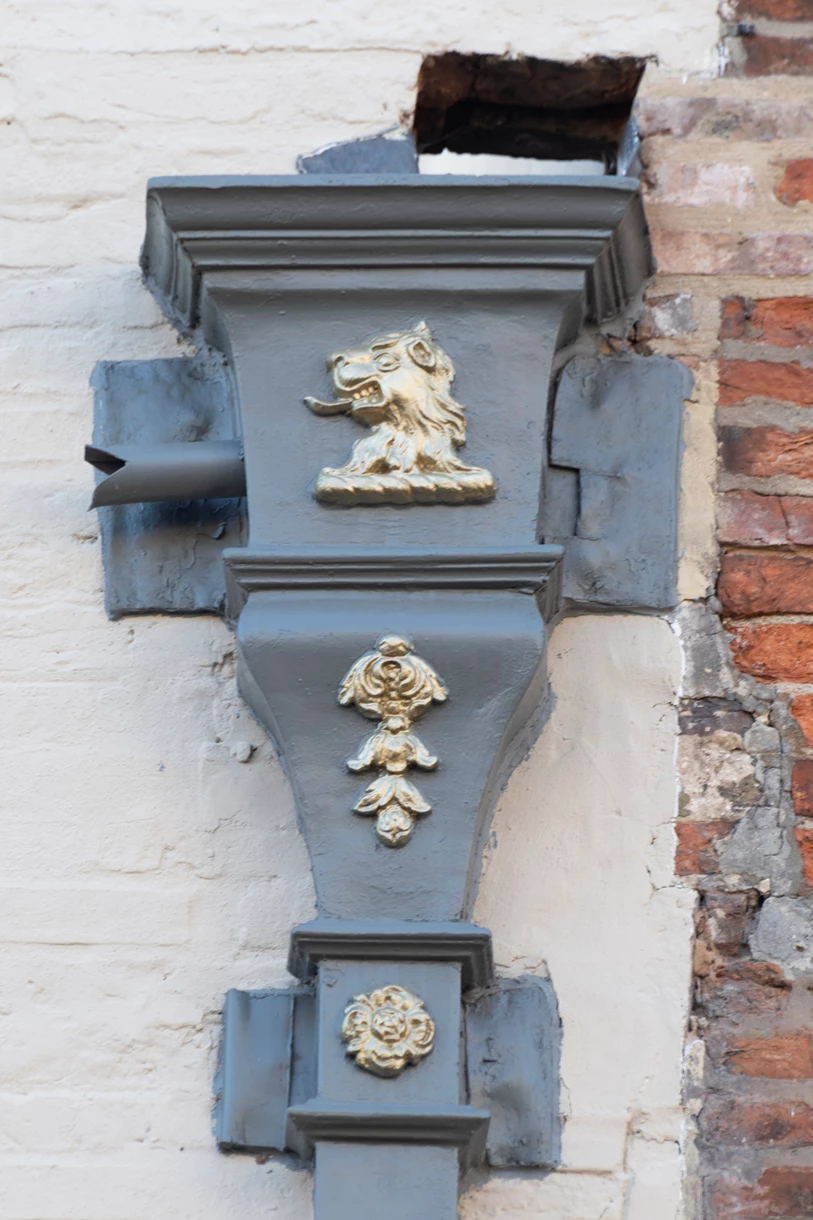

An important element of our forthcoming Climate Resilience policy is the need for informed decision-making about resilient rainwater systems that can sustain and preserve the wider fabric of the historic buildings in our care. One aspect of this challenge is what to do about timber troughing.
Keeping buildings watertight is at the very heart of building conservation, yet, due to our weather’s increasingly heavy rainfall, the traditional timber troughing or guttering found on some of our old buildings, is rotting faster and failing more often than ever before. In effect, shallow wooden gutters are regularly overtopped. Lacking capacity, and blocked by increasing amounts of moss and vegetation, water cascades down walls, washing away mortar and drenching brickwork. And, wet walls mean damp, cold interiors.
In this article, we explore one of the many challenges faced by our old buildings through climate change, timber troughing, and the shift towards more climate resilient conservation.
The York Conservation Trust are the proud owners and custodians of 70 historic properties in and around York. This includes some of the city’s most significant medieval and post medieval buildings, such as St Anthony’s Guildhall, the Assembly Rooms, York Theatre Royal, and Herbert House. In 2024 the Trust committed to investing £17m over the next decade on the conservation, repair and upgrade of its estate, seeking to ensure York’s built heritage remains safe for future generations. Work is already underway at sites across the city, including 77 Walmgate, 83-89 Micklegate, and 60 Goodramgate.
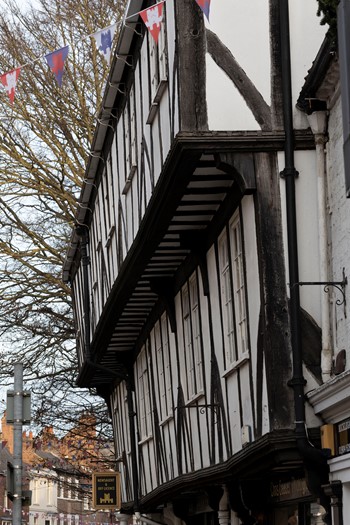
Numbers 85 - 89 Micklegate, a timber-framed row dating from c.1500, where York Conservation Trust has just undertaken a scheme of conservation and repair.
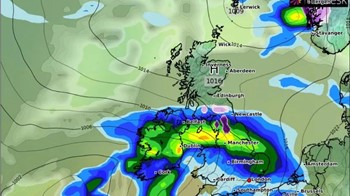
Rainfall data confirms that weather patterns are changing, with more rainfall falling annually.
This is a significant and important undertaking, and one that closely aligns with one our founder’s, John Bowes Morrell, principles of Duty, People and Place. The Trust’s 10-year plan seeks to balance the best interests of our buildings, our tenants, and the city. By carrying out best-practice conservation to create desirable homes, shops and offices within historic buildings, we can help sustain York’s heritage craft skills and support the local economy. This will also help to preserve and enhance the historic character of our streetscapes that are so important in making York the city it is. The biggest challenge presently facing building conservation is climate resilience. This has sparked debates and a flurry of guidance on adaptation to keep historic buildings warm and comfortable, particularly focusing on the addition of insulation, double-glazing and photovoltaic cells (solar panels).
The sector’s most important climate resilience challenge, however, is how we keep historic buildings dry as the frequency and intensity of rainfall increases. UK rainfall data confirms that weather patterns are changing, with more rain falling annually, and heavy downpours are now more common and more severe than they have previously been across the lives of our historic buildings. This is a national problem, but data suggests it is one that disproportionately affects the North and Scotland.
Wetter weather means increased moss and plant growth on buildings, which can clog gutters, hoppers and downpipes and result in water cascading down buildings. The increasing intensity of heavy downpours not only washes more moss into gutters, but also often overwhelms historical rainwater goods, overtopping gutters and backing up narrow downpipes.
Keeping buildings watertight is at the very heart of building conservation, so we need to adapt our rainwater systems to ensure that old buildings perform today and into the future. But how can we sensitively adapt historic buildings to ensure they have resilient and effective rainwater management without harming the heritage significance of individual buildings, or the wider historic streetscapes of York? We are not alone in struggling to address this issue, as demonstrated by the York Museums Trust’s widely publicised leaky roof problems at the Yorkshire Museum. Due to the critical importance of managing water, the only solution is to accept change, but we must strategically manage that change and ameliorate its impact. This was recently supported by an Historic England article on resilient rainwater systems in 2024, updated in June 2025, which stated:
"Changes to rainwater goods on listed buildings or scheduled monuments as a response to design or capacity shortfalls are likely to be acceptable if the impact to the building's significance is minimised."
The York Conservation Trust is presently developing a Climate Resilience policy to inform its current and future work. These will develop on the guidance provided by Historic England (2024 and 2025) and the broader principles for climate change in the National Planning Policy Framework Chapter 14 (NPPF 2025). An important element of this policy will be making informed decisions to ensure resilient rainwater systems that can sustain and preserve the wider fabric of the historic buildings in our care. One of the thorniest aspects of this challenge is what to do about buildings with timber gutters, known as timber troughing.
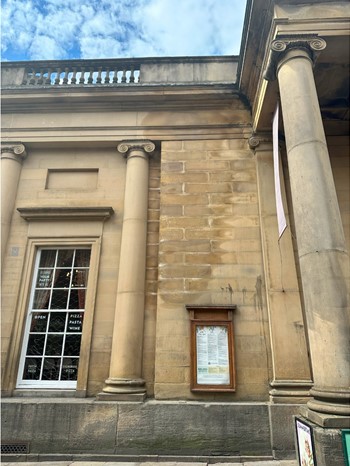
York's Assembly Rooms showing water damage, as rainfall goods become overwhelmed from more frequent and heavier downpours.
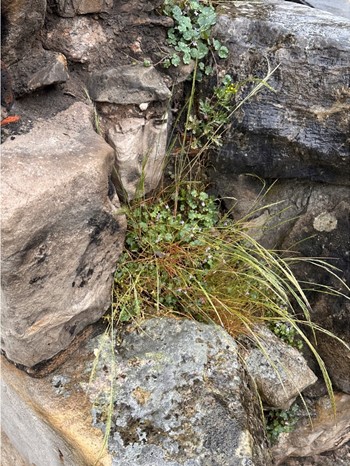
Wetter weather means increased moss and plant growth.
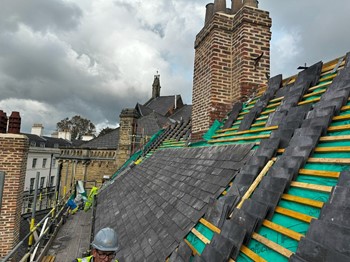
The York Conservation Trust is presently developing a Climate Resilience policy.
Timber has been a traditional material for rainwater goods in York since the medieval period, although these were comparatively rare before the 18th century. A reconstructed version of early timber troughing with a timber downpipe can be seen on Kirkgate in the York Castle Museum. Most medieval buildings, however, had roofs with large overhangs and no eaves guttering - rainwater simply ran down the roof slopes and off the edge, with the overhangs ensuring the runoff fell to the ground and not onto the sheltered walls. Many of the decorative features of historic walls also served the purpose of shedding water off walls, to fall instead onto the footpaths and yards below.
It was not until a local Act of 1763 that rainwater goods became required in York, and many of the city’s surviving historic lead hoppers bear the dates 1763 or 1764, as owners responded to this new legislation. In the 18th-century wealthier properties employed long-lasting lead for their rainwater goods, with the roof and guttering often hidden behind a fashionable parapet wall. Elsewhere, much cheaper but limited-life timber troughing was used. Appearance was everything in Georgian architecture, often resulting in complex roof shapes with awkward and poorly designed rainwater systems and commonly leaking roofs. In 1752 renowned architect, John Carr, was commissioned to fix the constantly leaking roof of the Assembly Rooms less than 20 years after it was constructed. It was not until the 19th century that mass-produced cast iron guttering and downpipes became the predominant material for rainwater goods, although timber troughing continued to be used on lower status properties.
In the early twentieth century, Arts & Crafts architects often used decorative timber gutters on higher status buildings, especially on restored historic timber-frames. The York Conservation Trust owns several restored medieval and post medieval timber framed buildings with 20th-century timber gutters. Although York has a long history of timber troughing, due to its short lifespan, most of the surviving examples date from the 20th century.
Prior to the introduction of cavity walls in the mid 19th-century buildings were constructed with solid walls, known as mass wall construction. Keeping solid walls dry is especially important, as they can allow moisture to permeate through to interiors. Traditional materials, such as lime mortars and plasters, allowed moisture to escape back outside, but modern cementitious mortars, gypsum plasters and latex paints can lead to moisture being trapped inside solid walls, causing issues internally. The failure to keep solid walls dry results in damage to internal plasterwork and promotes mould, making homes cold and unhealthy.
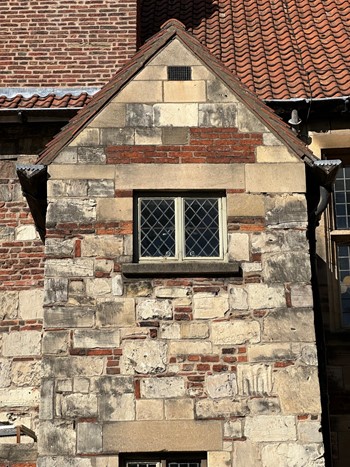
Distinctive V-shaped timber guttering with decorative lead lining, often employed by early 20th Century architects such as Walter Brierley, including here on King’s Manor.
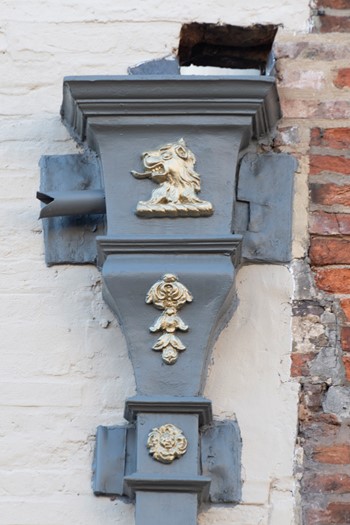
Lead rainwater hopper at 69/71 Micklegate.
Capacity Issues
As traditional timber troughing is channelled into a solid piece of timber, it can only be made with a very limited capacity. Historically this smaller capacity was usually adequate, as heavy downpours were rarer and generally not as intense as they are today. Due to York’s changing climate, the historical design and capacity of timber troughing is often no longer capable of coping with present or predicted future rainfall. Walking the pedestrianised streets of York during heavy rainfall reveals numerous overflowing gutters pouring onto the buildings and people. Shallow timber troughing is particularly susceptible to overtopping during downpours, with the guttering quickly filling to capacity and water cascading over the front lip and down the wall below. This not only causes damage to the exterior wall fabric, washing out mortars and drenching bricks, but also impacts historic interiors. Upgrading these traditional gutters by creating higher capacity troughing channelled into larger timbers is prohibitively expensive and creates structural and design issues due to the required size and weight of the larger timber. Supporting corbels would often need to be moved to allow for the larger timbers and additional structural supports provided, all resulting in considerable impact on the fabric and appearance of buildings.
Although not a traditional technique, it is possible to construct timber gutters by joining multiple timbers together rather than channelling into a single timber. This represents, however, a significant change from traditional troughing construction and presents its own challenges. Lined composite timber gutters are time-consuming - and thus expensive - to make, and their many joins make them extremely difficult to prevent from leaking and rotting. A few years ago, the York Conservation Trust experimented with a bespoke timber gutter formed from multiple timbers with a lead lining, commissioned at great expense. Although this superficially looked like traditional timber troughing, composite timber gutters are otherwise an entirely modern intervention, and thus do not represent best conservation practice. Despite being of good design and materials, within three years this gutter had started to leak, allowing water to damage the timber joints, and crucially, to soak the newly restored historic timber-framed wall below.
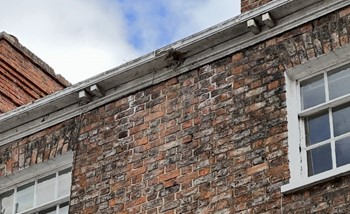
Failed 20th-century timber troughing on High Petergate, showing a point of failure and overtopping. Note the damage to brickwork and washed-out mortar below where rainwater has run down the wall.
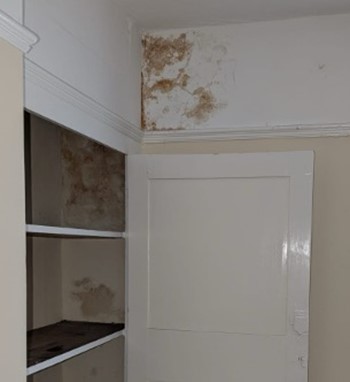
Failed timber troughing on High Petergate has resulted in water ingress, damaging historic plasterwork and affecting the timbers.
Maintenance Issues
Timber troughing has a much shorter lifespan than other materials traditionally used for rainwater goods such as cast iron. It is also far more prone to failure, as it is difficult to seal at the joins and therefore requires considerable maintenance. The Trust has experimented with lead linings, bitumen and neoprene sealants, but all have quickly failed, again resulting in damage to historic material below. The shallow capacity of timber troughing also results in comparatively quick silting up of the channel, promoting further moss and vegetation growth. Silting also prevents the timber troughing from fully drying out, speeding up wood decay and further shortening the lifespan of these rainwater goods. The changing climate has also impacted the quality of timber available for new troughing, with modern timber being much more quickly grown, resulting in a more open structure that is itself less resilient and more susceptible to decay.
Timber troughing therefore requires significantly more maintenance and much more frequent repair and maintenance than other traditional forms of guttering, with all the associated time and cost implications these entail. Where timber troughing is difficult to access, such as on jettied timber-framed buildings or on taller buildings, replacement and maintenance often requires scaffolding, with the need for scaffolding licenses, road closures etc., adding yet more cost and inconvenience for all. Maintenance burden has rightly never been a justification for change to historic buildings, however, in the 21st century it perhaps needs to be given slightly more weight. Maintaining historic buildings is getting ever more expensive and challenging to carry out. This inevitably reduces the likelihood custodians can or will carry out timely maintenance, resulting in increased risk of damage to historic fabric. York Conservation Trust has certainly been guilty of this in the past, although we are working hard to address past lapses. The Trust already spends in the order of £350k per year on maintenance, with more set aside for the coming years. This is on top of the £17m allocated for conservation repairs and upgrades. Even ignoring the costs of maintaining historic rainwater systems, owners still face the challenge of occupiers, residents and tourists understandably not wanting intrusive scaffolding on their historic streets .This scaffolding often also presents unwelcome additional challenge for accessible users of York’s streets.
The potential damage from no longer fit-for-purpose timber troughing can also have an important public safety element. In 2024 a brick corbel fell from height off a York Conservation Trust property, landing on the - thankfully empty – pavement below. Investigations revealed that leaking timber troughing had completely washed out the mortar supporting the brickwork at the top of the wall. This damage was not visible without removing the gutter from a scaffold and must have been occurring undetected for years despite condition surveys and regular gutter clearing. This highlights just how important it is to ensure rainwater goods are performing and fit-for-purpose.
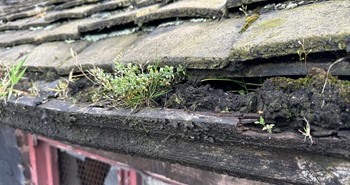
If not regularly maintained, shallow timber troughing fills with silt, encouraging moss and plant growth. This rapidly reduces the capacity of the gutter, and keeps it permanently wet, resulting in deterioration of the timber and gutter failure.
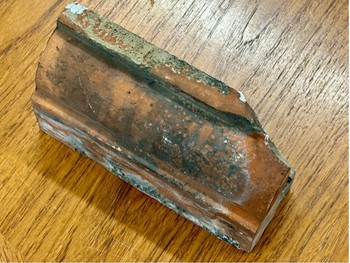
A brick corbel like this fell to the pavement from a YCT property in 2024.
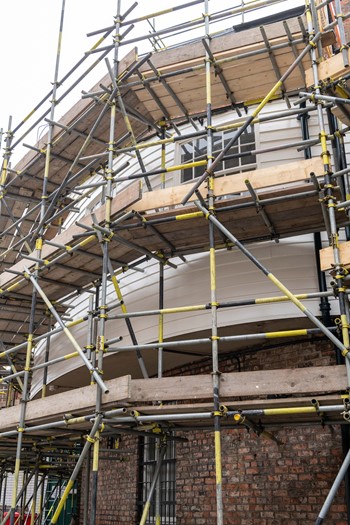
Scaffolding always represents an unwelcome issue for traders and an accessibility challenge for users of York's streets.
More strategic and nuanced decision-making is required around balancing harm through change versus harm through failure to adequately manage water runoff on historic buildings. While the York Conservation Trust acknowledges the evidential and aesthetic value of traditional timber troughing within the city, it argues that in many instances it is no longer fit-for-purpose. So how can we make informed decisions about what’s best for the building and for preserving York’s rich and complex built heritage?
Understand Significance and Embrace a more Holistic Approach
The first step to informed decision-making is to gain a better understanding of timber troughing in the city through research and recording. Where does it survive, how old is it, and how long has that type of guttering been on the building? We’ve found examples of historic cast iron guttering being replaced by timber troughing as late as the 1960s! What contribution does the timber troughing make to the overall significance of the site, and to the wider setting of the historic cityscape. A thematic study of timber troughing across the city would be welcome for understanding its survival. This information would help inform decisions around how to best preserve the city’s heritage, both generally and for specific buildings.
Where evidence suggests timber troughing has a strong historical precedence or is associated with an original design or significant architect, then there is a stronger argument for its preservation. For instance, the York Conservation Trust will always seek to repair and retain the early 20th century timber guttering associated with timber-frame restorations by renowned architectural firm, Brierley & Rutherford, for one of our founders, Mr Cuthbert Morrell. But where the timber troughing is less significant than the fabric it serves to protect, change should be considered and supported to ensure a resilient rainwater management system that can sustain the building’s significant into the future.
Embrace Climate Change Resilience
Conserving historic buildings is an expensive undertaking, and difficult decisions need to be made as to how best to spend limited funds to sustain and preserve as much heritage as possible. This includes balancing decisions of significance against the more commercial realities of access, scaffolding and maintenance costs. Considering the changing climate and limited funding available for historic buildings, the city’s heritage organisations, including York Conservation Trust, need to be more strategic in how we collectively respond to the many challenges facing built heritage, especially emerging threats such as Climate Change. Attitudes have recently started to shift in how we judge the harm versus benefit of solar panels on historic buildings. Accepting change to timber troughing where it is no longer effective or resilient is a small compromise to protect and sustain the city’s historic buildings. To minimise the visual impact of changing from timber to cast-iron, moulded square-section profile guttering can be utilised, which is of similar size and appearance but has significantly increased capacity, an increased lifespan, and significantly reduced maintenance burden.
If historic buildings are not kept watertight, we accept not only a damage to heritage, but risk upper floors of city-centre buildings falling back out of use, as residential and commercial occupiers seek warmer, healthier, lower-maintenance accommodation that meets modern living and working standards. The Council for British Archaeology recently explored the challenges facing Britain's high streets, noting the importance of using upper floors over shops to ensure buildings are maintained, to address the national housing shortage, and to breathe new life into our urban centres. Focussing on climate resilience in historic buildings is an important factor in addressing these wider challenges.
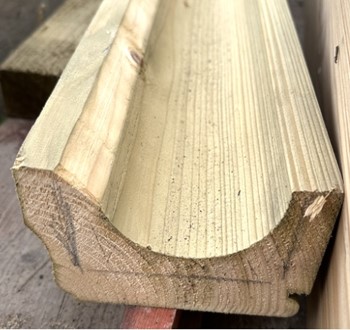
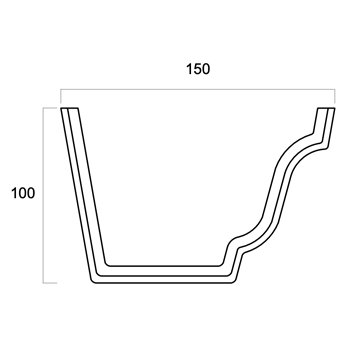
New timber troughing (above), with shallow depth and lack of capacity. Compared to the cross section (below) of a similarly sized cast iron gutter, it is clear there is increased capacity.
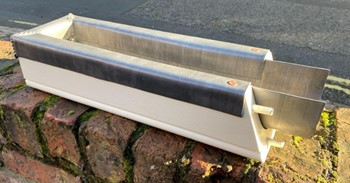
Bespoke, higher capacity timber gutter with lead lining. A non-traditional compromise which soon began leaking once in situ.
Here at the York Conservation Trust, our role is to support the people of York through the conservation and protection of the buildings in our care. As homes, offices, workshops, theatres and restaurants; we are creating and caring for unique places for people to live, work and play.
To do this effectively, we must take on the challenge of climate change.
Together with our partners across the heritage sector and local authorities, with the support of our tenants and the wider public, we must make every effort to protect what we have and ensure its continued future use and enjoyment.