

77 Walmgate
From desirable medieval address to Victorian poverty, survivor of the 1950s slum clearance and rescued for a new lease of life.
Broadly following the route of a major Roman road, today, apart from Walmgate Bar and the medieval parish churches of St Margaret’s and St Denys’s, there are few visible traces of Walmgate’s historic streetscape. By the 14th-century the powerful rival Neville and Percy families (Earls of Warwick and Northumberland respectively) both had houses on Walmgate, together with the Guild of Haberdashers’ guildhall, reflecting the street’s high status.
A two-storey timber-framed building, no. 77 Walmgate comprised a 15th-century timber-framed cross wing and a late 16th-century timber-framed hall range. The 15th-century range was constructed at the same time as the now-largely-rebuilt adjacent hall range with cross wing to the east (no.75).
Despite its prosperous beginnings, by the 17th century Walmgate’s fortunes had reversed, and it was recorded as one of the poorest wards in York. This association with poverty continued into the 19th century, particularly following the influx of Irish immigrants escaping the Great Famine in the 1840s, who flocked to the many rear courts and yards behind Walmgate. Working at the cattle markets outside Walmgate Bar or on nearby farms outside the walls, the immigrants could only afford dilapidated and overcrowded accommodation. Larger buildings on Walmgate were converted into lodging houses, and the whole area became associated with poor living standards, sickness and infant death.
In a move by the city to purge large areas of dilapidated, insanitary buildings, the 1950s saw widespread ‘slum’ clearances taking in Walmgate, and resulting in the loss of many of the street’s historic timber framed buildings.
Very little is known about the early history of the site. The ground floor front wall and east gable were historically rebuilt in brick, while to the rear, the property was extended in brick during the 18th century.
Originally numbered as no.150 Walmgate, the earliest identified record for the site is the 1841 census, which lists the occupants as John Thompson (34), coach lace and fringe manufacturer, living with his sister Jane (25), and Jane Smailes (14). By the late 1840s it appears Thompson had moved to a nearby house, and no.77 was used solely as a shop and warehouse.
A long-term occupant, advertisements for Thompson’s business regularly appeared in the York Herald newspaper into the 1870s, describing him as a: “wholesale and retail girth web manufacturer, woollen merchant, and saddler's ironmonger".
By 1877 the property was occupied by another saddler Arthur Kay. An 1879 advert offered “good stables and a yard to let”, presumably referring to the rear of the site. By 1883, things weren’t going so well for Arthur who appeared in a published list of debtors, and probably moved out that year.
By 1885 the property had been converted to a lodging house, operated by Edward Crane. At this time, no.77 was one of several properties on Walmgate owned by William Hotham, a retired common brewer. Following William Hotham’s death in July 1891, no.77 was advertised for sale, noting it was “let at a rent of £20 per year” and was in the occupation of Mr F. Hansell. A later article in the York Herald reported the property had been purchased by Mr Thomas Langstaff, of no.40 Walmgate, for £380.
No.77 Walmgate appeared in several York Herald articles across the early 1890s, giving us a glimpse into the poverty of the building’s occupants. The articles recount theft and the tragic and untimely deaths of both children and adults. The last article noted that three male lodgers were sharing a room, showing us just how crowded the small house must have been at the time.
In 1901 the lodging house was being run by Anna Hustwick. Anna, a 63 year-old widow lived at the property with her son John (36), granddaughter Minnie (15), Joseph Downey a four-year-old “nurse/child”, as well as eleven male lodgers. Despite Walmgate’s strong association with the Irish community, only one lodger, Michael Forrester, was listed as Irish. From 1902 until 1914, the Electoral Registers show that Thomas Hustwick was still running no. 77 as a common lodging house.
The earliest known image of the building is from around 1905 showing a dirty property in poor condition; the timber framing rendered over, and a small casement window on the upper floor. A sign projected over the doorway advertising the lodging house.
A deed of 1920 then records the sale of no.77 to Richard Hawthorne, glass merchant. R & J Hawthorne owned the St Margaret’s Glass Warehouse in nearby Pavers Lane, off Walmgate. The deed notes that the property was “formerly in the occupation of Francis Hansell as a common lodging house but now of Mary Helstrip and others”. This aligns with the 1921 census, which recorded Mary Elizabeth Helstrip (lodging housekeeper), who lived there with five children and nine lodgers. One lodger, Emma Simpson, was also listed as working at no. 77 as a charwoman. Mary, Thomas and Stanley Helstrip appear in various directories at the site until 1926.
In July 1935 the building was bought by Cuthbert Morrell, no doubt saving it from later slum clearances, and he employed the renowned architects Brierley, Rutherford & Syme to restore it. They removed the 18th-century render, restoring the late-medieval timber framing, and largely rebuilt the brick extension to the rear. In 1957 the building was bought by the Ings Property Company. Formed by Cuthbert and his brother John Bowes Morrell, this company was the forerunner of the York Conservation Trust.
Significantly altered in 1980 to form two shops with an upstairs flat. A new shop doorway was added to the front elevation, and the internal staircase realigned to create larger shop spaces. Never successful as retail spaces, in 2003 the ground-floor shops were converted into a one-bedroom flat, with the 1980 doorway infilled and new oak oriel windows added.
The Next Chapter
In 2025, York Conservation Trust started the next phase of no. 77 Walmgate’s history, with an ambitious conservation repair scheme. The project carefully restored the historic fabric and added a modern kitchen extension with a link to create a desirable 3-bedroom house with courtyard garden, removing modern services and interventions from the historic spaces. This example of sustainable conservation-led development breathes new life into this historic survivor.
In the early stages of the repair works, it became clear that a significant repair would be required to the timber frame. Working closely with conservation-specialist engineers and traditional timber-framing craftspeople to understand the necessary repairs to the 600-year-old oak framing, minimal interventions were made using steelwork and modern replacement air-dried oak.
Timber repairs utilised traditional carpentry joints. These skills go back hundreds of years, but when seen today they still look incredibly innovative. As an example, slip-tenon joints were utilised to repair the crownpost timbers.
After years of mixed retail and residential, this historic building has been brought back to life as a family home, blending the old and new. One of the first projects in the Trust’s newly developed 10-year plan for our estate, it exemplifies the benefits of sensitive new design to better utilise historic buildings. No. 77 will, once again, be home to a family in the heart of the city.
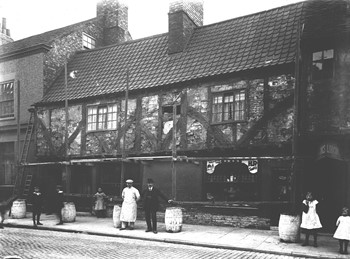

From its heyday as a highly desirable late medieval, Tudor residence, a dilapidated and crumbling 77 Walmgate at the end of the 19th century.
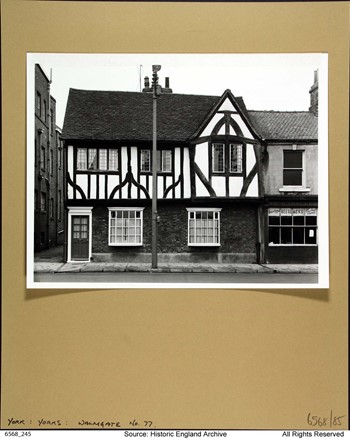

Courtesy of Historic England Archive, 77 Walmgate c. 1905.
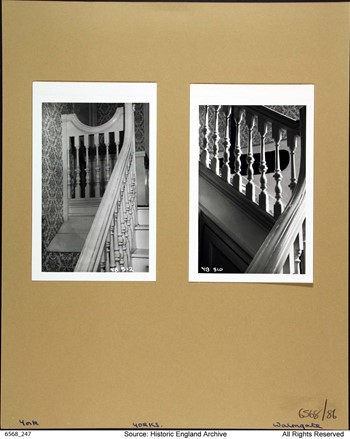

Courtesy of Historic England, internal staircase, c. 1905.
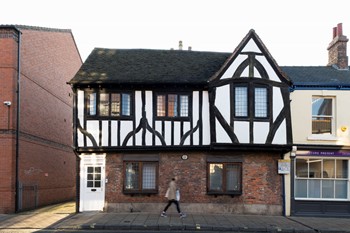

77 Walmgate today.
Discover more about 77 Walmgate
77 Walmgate
York
YO1 9TZ
Historic England Grade ll* listed building.
Residential property.